
For the Treatment of OCD and
Related Anxiety Conditions
OCD Treatment: Cognitive-Behavioral Therapy
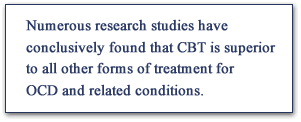
For many years, the treatment of OCD was thought to be exceptionally difficult. Traditional psychoanalysis consistently had little impact on the disorder, and other psychotherapies were equally unsuccessful. However, over the past fifteen years, developments in Cognitive-Behavioral Therapy (CBT) have resulted in an OCD treatment protocol that is especially beneficial for individuals with this condition. In fact, numerous clinical studies conducted over the past fifteen years have conclusively found that CBT, either with or without medication, is dramatically superior to all other forms of treatment for OCD.
Compared to traditional psychotherapy, in which sessions are spent merely discussing the client’s problems, CBT treatment for OCD is far more proactive. Working together, both the client and the therapist take active roles in assessing the problem, and in devising concrete, active steps towards alleviating the symptoms. Using the Yale-Brown Obsessive Compulsive Scale (YBOCS) and numerous other assessment tools, the therapist helps the client create a detailed list of his or her symptoms. This symptom list is then used as the primary tool in a form of CBT treatment called Exposure and Response Prevention (ERP), or “exposure therapy”.
 Using this symptom list, the client experiments during treatment sessions with exposure to his or her fears, starting with the least anxiety-provoking items from the symptom list. Regular “homework” assignments are given so that the client can continue to challenge symptoms between therapy sessions. These homework assignments are specifically designed for each individual client, and are an essential part of treatment for OCD and related anxiety conditions, including Body Dysmorphic Disorder (BDD), Hypochondria (health anxiety), Panic Disorder, Social Anxiety, and Phobias. These homework assignments are particularly valuable in helping clients challenge certain symptoms that occur at home, at work, or at school, and that cannot easily be duplicated in the therapy office.
Additionally, a variant of ERP called imaginal exposure is frequently used in the treatment of OCD, OC Spectrum Disorders, and related anxiety disorders. Imaginal exposure involves writing short stories based on the client’s obsessions. These stories are used as ERP tools, allowing the client to experience exposure to their fearful thoughts. This form of exposure therapy is particularly beneficial for obsessions that cannot be experienced through traditional ERP (e.g., killing one’s spouse or molesting a child). When combined with standard ERP, and other cognitive-behavioral techniques, imaginal exposure stories can help to greatly reduce the frequency and magnitude of these intrusive obsessions, as well as the individual’s sensitivity to unwanted thoughts and mental images. To learn more about imaginal exposure, click here.
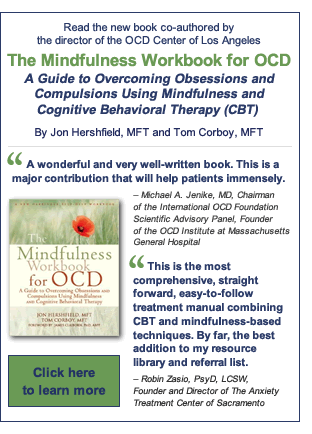
One of the most effective CBT developments for the treatment of Obsessive-Compulsive Disorder (OCD) and related conditions is Mindfulness-Based Cognitive-Behavioral Therapy. The primary goal of Mindfulness-Based CBT is to learn to non-judgmentally accept uncomfortable psychological experiences. From a mindfulness perspective, much of our psychological distress is the result of trying to control and eliminate the discomfort of unwanted thoughts, feelings, sensations, and urges. In other words, our discomfort is not the problem – our attempt to control and eliminate our discomfort is the problem. For an individual with OCD or a related anxiety-based condition, the ultimate goal of mindfulness is to develop the ability to more willingly experience their uncomfortable thoughts, feelings, sensations, and urges, without responding with compulsions, avoidance behaviors, reassurance seeking, and/or mental rituals. To learn more about Mindfulness Based CBT, click here.
Following a structured CBT protocol, the client gradually challenges all of his or her symptoms, and learns new, more productive methods of coping with anxiety. Over time, the individual becomes de-sensitized to previously anxiety-provoking situations and thoughts, and the obsessions and compulsions are eliminated, or significantly reduced in frequency and magnitude. Using this treatment approach, most clients make dramatic improvement by meeting with their therapist on a weekly basis over a period of just 4-6 months, followed by two or three “booster sessions”. Some clients may also benefit by having a small number of family or couples therapy sessions to address the impact OCD is having on their relationships. And a minority of clients may require a more intensive approach that includes 2-3 sessions per week or even home visits.
CBT Combined with Medication for the Treatment of OCD and Anxiety Conditions
Some individuals with OCD, OC Spectrum Disorders, or related anxiety disorders, may also benefit from combining CBT treatment with one or more medications that are sometimes prescribed for these conditions. The goal of medication, or “pharmacotherapy,” is to reduce obsessional anxiety, thereby increasing the individual’s ability to utilize and benefit from CBT treatment. This is particularly helpful with clients for whom the prospect of exposure therapy is so anxiety-provoking that they are initially unwilling to try CBT. For these individuals, after the medication has begun to reduce their obsessions, it is recommended that they complete a regimen of CBT while continuing the pharmacotherapy. Medication may also be beneficial for individuals experiencing depression, which is sometimes present in those with OCD and related disorders, or with other psychiatric conditions.
But it is important to stress that CBT is the primary treatment for OCD. Numerous research studies completed over the past twenty years have concluded that CBT is the most effective treatment for OCD. In fact, in 1997, the Journal of Clinical Psychiatry surveyed over sixty OCD researchers and treatment specialists from across the world in order to determine the best treatment for OCD. The resulting publication, entitled Expert Consensus Treatment Guidelines for Obsessive-Compulsive Disorder, described CBT as “the psychotherapeutic treatment of choice for children, adolescents and adults with OCD” and noted that it is “the key element of treatment”.
Despite this endorsement, many clients are tempted to rely on medication alone. But four facts provide a compelling case against the “medication-only” route. First, analyses of numerous studies comparing CBT and pharmacotherapy have concluded that CBT treatment for OCD is more effective in both the short and long-term. Second, the potential short-term side-effects of these medications are well-documented and include anxiety, insomnia, nausea, diarrhea, difficulty concentrating, and sexual dysfunction. Conversely, CBT has no side-effects. Third, many of these medications have not been fully studied over an extended period of time, and many researchers and clinicians are concerned about the possibility of long-term side-effects, particularly for children, and for pregnant or breast-feeding women. And finally, studies have shown that when individuals treating OCD exclusively with pharmacotherapy discontinue the medication, as many as 90% may experience a complete return of their OCD symptoms. Conversely, those who complete a course of CBT treatment for OCD usually have a far lower rate of relapse. With CBT, the techniques you learn are always with you and provide a set of tools that can immediately be utilized if and when symptoms return.
or call us at 310 824-5200
Group Cognitive Behavioral Therapy (CBT) for OCD and Anxiety
In addition to individual therapy, the OCD Center of Los Angeles also currently offers five weekly therapy/support groups for adults, all of which are conveniently scheduled on weekday evenings or Saturdays. Research has shown that group Cognitive-Behavioral Therapy can be extremely helpful in the treatment of OCD (including Pure Obsessional OCD and Postpartum OCD) and related anxiety conditions, including Body Dysmorphic Disorder (BDD), Hypochondria (health anxiety), Panic Disorder, Social Anxiety, Phobias, Trichotillomania (hair pulling disorder), and Dermatillomania (skin picking disorder). All of our groups are lead by our professional staff therapists, and use the same treatment protocol as our individual Cognitive-Behavioral Therapy program. To learn more about our weekly groups for adults with OCD and related conditions, click here, or call us at (310) 824-5200 (ext. 4).
Online Cognitive Behavioral Therapy (CBT) for OCD and Anxiety
The OCD Center of Los Angeles also offers webcam-based online therapy and telephone therapy to clients around the world. Our telephone and online therapy program uses the same Cognitive Behavioral Therapy treatment protocol that we use with our face-to-face clients. Telephone and online therapy are cost-effective options for clients who have physical and/or psychological limitations that restrict their ability to come to our office, and for those in remote areas who cannot find specialized OCD and anxiety treatment close to their home. Telephone and online therapy have repeatedly been found to be safe and effective in numerous research studies, and have been legal in California since 1997. If you would like to learn more about our telephone and online therapy program for Obsessive Compulsive Disorder (OCD) and related anxiety based conditions, please click here.
Intensive Cognitive Behavioral Therapy (CBT) for OCD and Anxiety
We also offer an intensive treatment program for adults, adolescents, and children with OCD and related anxiety conditions. This program utilizes the same Cognitive Behavioral Therapy that we use in our standard outpatient program, and is designed to provide specialized intensive treatment to individuals for whom traditional outpatient therapy is either unavailable or insufficient. Our intensive outpatient program is ideal for clients from other states or countries who cannot find effective treatment near to their homes, and for those whose symptoms require a more rigorous treatment protocol. To learn more about intensive outpatient treatment for OCD and related anxiety conditions, click here.
About the OCD Center of Los Angeles
The OCD Center of Los Angeles is a private outpatient treatment center specializing in CBT for the treatment of OCD and related anxiety based conditions. We have 14 therapists on staff, all of whom are either licensed or registered, and all of whom specialize in CBT. We treat adults, adolescents, and children, and offer services six days a week, including evenings and Saturdays.
We have 3 Southern California offices located in:
- Brentwood
- Pasadena
- Newport Beach
If you would like more information regarding Cognitive-Behavioral Therapy (CBT), or would like to discuss individual therapy, group therapy, telephone or online therapy, or intensive treatment for OCD or a related anxiety based condition, you can call the OCD Center of Los Angeles at (310) 824-5200 (ext. 4), or click here to email us.


