
Postpartum OCD, and Related Conditions
Perinatal / Postpartum OCD – Symptoms And Treatment
Perinatal / Postpartum OCD is a significant problem that can affect expectant and new mothers. Perinatal refers to the period of time from approximately 4-5 months prior to giving birth to one month after giving birth. Postpartum refers to the first 2-3 months after giving birth. Perinatal and postpartum mental illnesses range from the relatively benign “baby blues” to the most severe, postpartum psychosis. It is estimated that anywhere from 60%-80% of new mothers will experience the depressed mood often called the “baby blues”. These symptoms often ameliorate within a week of onset, and do not warrant treatment. Postpartum depression, which afflicts approximately 10%-20% of new mothers, is more severe and lasts for a longer period of time. Postpartum OCD affects approximately 3-5% of new mothers, and has symptoms similar to those seen in others with OCD. In mothers with Perinatal / Postpartum OCD, the focus of the obsessions is often on the fear of purposely harming the newborn, or somehow being responsible for accidental harm.
Symptoms of Perinatal / Postpartum OCD
Symptoms of Perinatal / Postpartum OCD vary widely from mother to mother. Some examples of common obsessions seen in Perinatal / Postpartum OCD are:
- Horrifying, intrusive thoughts of stabbing or suffocating a newborn child
- Unwanted images of throwing or dropping a baby
- Disturbing thoughts of sexually abusing a child
- Fear of accidentally harming a child through carelessness
- Intrusive thoughts of accidentally harming the fetus or child by exposure to medications, environmental toxins, germs, chemicals, or certain foods
- Fear of being responsible for giving a child a serious disease
- Fear of making a wrong decision (i.e., getting inoculations, feeding certain foods, taking antidepressants) leading to a serious or fatal outcome
Some common examples of compulsions seen in Perinatal / Postpartum OCD include:
- Hiding or throwing out knives, scissors, and other sharp objects
- Avoiding changing soiled diapers for fear of sexually abusing a child
- Avoiding feeding a child for fear of accidental poisoning
- Repeatedly asking family members for reassurance that no harm or abuse has been committed
- Avoidance of certain foods, medications, or normal, everyday activities for fear of harming the fetus
- Monitoring self for perceived inappropriate sexual arousal
- Avoiding news articles and TV shows related to child abuse or infanticide
- Repeatedly and excessively checking in on a baby as he/she sleeps
- Mentally reviewing daily tasks and events in an attempt to get reassurance that one has not harmed a child or been responsible for harm to a child
Unfortunately, Perinatal / Postpartum OCD is quite often misdiagnosed as being depression. The reason for this appears to be three-fold. First, many women with Perinatal / PostpartumOCD also have depression. While some experts estimate that as many as 30% of new mother with postpartum depression also have postpartum OCD, one recent study found that 57% of new mothers with postpartum depression also had symptoms of Postpartum OCD. Second, many pediatricians, obstetricians, psychiatrists and psychologists do not fully understand the nature of Perinatal / Postpartum OCD, and thus misunderstand the symptoms being reported. And third, Perinatal / Postpartum OCD is often a very secretive condition. New mothers are often reluctant to tell anyone of their obsessions for fear that they will be seen as “crazy” or a danger to the child.
Treatment of Perinatal / Postpartum OCD
Fortunately, the treatment of Perinatal / Postpartum OCD is essentially the same as other instances of OCD. A specific type of Cognitive-Behavioral Therapy (CBT) known as “Exposure and Response Prevention” (ERP) has proven to be very successful in the treatment of most subtypes of OCD, including Perinatal / Postpartum OCD. Another CBT technique that is extremely valuable in the treatment of Perinatal / Postpartum OCD is called “Cognitive Restructuring”, in which mothers learn to challenge the validity of the disturbing, unwanted thoughts and images they are experiencing.
Additionally, a variant of ERP has been developed that has also been found to be extremely effective with the “pure obsessional” symptoms often seen in Perinatal / Postpartum OCD. This method, called imaginal exposure, involves writing short stories based on the mother’s obsessions. These OCD stories are then used as ERP tools, allowing the client to experience exposure to situations that cannot be experienced through traditional ERP (e.g., killing or molesting a child). When combined with standard ERP for the above-noted compulsions, and other CBT techniques, imaginal exposure can greatly reduce the frequency and magnitude of these intrusive obsessions, as well as the mother’s sensitivity to the thoughts and mental images experienced in Perinatal / Postpartum OCD. To learn more about imaginal exposure, click here.
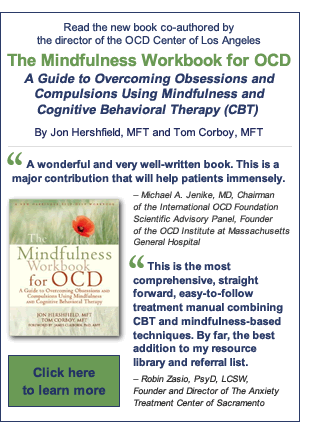 One of the most effective CBT developments for the treatment of Perinatal / Postpartum OCD is Mindfulness-Based Cognitive-Behavioral Therapy. The primary goal of Mindfulness-Based CBT is to learn to non-judgmentally accept uncomfortable psychological experiences. From a mindfulness perspective, much of our psychological distress is the result of trying to control and eliminate the discomfort of unwanted thoughts, feelings, sensations, and urges. In other words, our discomfort is not the problem – our attempt to control and eliminate our discomfort is the problem. For a woman with Perinatal / Postpartum OCD, the ultimate goal of mindfulness is to develop the ability to more willingly experience their uncomfortable thoughts, feelings, sensations, and urges, without responding with compulsions, avoidance behaviors, reassurance seeking, and/or mental rituals. To learn more about Mindfulness Based CBT for the treatment of Perinatal / Postpartum OCD, click here.
Using these tools, mothers learn to challenge their obsessive fears, as well as the compulsive and avoidant behaviors they use to cope with those fears. If you would like to learn more about Cognitive Behavioral Therapy for the treatment of OCD, Postpartum OCD, and related anxiety-based conditions, click here.
Individual Therapy for the Treatment of Perinatal/ Postpartum OCD
The OCD Center of Los Angeles offers individual therapy for the treatment of all types of OCD, including Perinatal / Postpartum OCD, with a strong emphasis on Cognitive Behavioral Therapy (CBT). We have 14 therapists on staff, and our offices are open six days a week, including evenings and Saturdays. If you would like to discuss treatment options at the OCD Center of Los Angeles, please call one of our client coordinators at (310) 824-5200 (ext. 4), or click here to email us.
Low-Fee Group Therapy for the Treatment of Perinatal / Postpartum OCD
In addition to providing individual Cognitive Behavioral Therapy (CBT), the OCD Center of Los Angeles also offers six weekly, low-fee therapy / support groups for adults suffering with OCD, Perinatal / Postpartum OCD, and related conditions. Research has shown that group CBT is extremely effective for the treatment of all types of OCD, including Perinatal / Postpartum OCD. All groups at the OCD Center of Los Angeles are led by our staff therapists, and use the same CBT treatment protocol as our individual therapy program. Please note that all of our groups require an assessment prior to participation, and are open only to adults over the age of 18 with OCD, Perinatal / Postpartum OCD, and related anxiety based conditions. For more information on our weekly groups for adults, click here.
Telephone and Online Therapy for the Treatment of Perinatal / Postpartum OCD
The OCD Center of Los Angeles also offers webcam based online therapy and telephone therapy to women around the world with Perinatal / Postpartum OCD. Telephone and online therapy are cost-effective options for those who have physical and/or psychological limitations that restrict their ability to come to our office, and for women in remote areas who cannot find specialized Perinatal / Postpartum OCD treatment close to their home. Telephone and internet therapy have repeatedly been found to be safe and effective in numerous research studies, and have been legal in California since 1997. If you would like to learn more about our telephone and online therapy program for Perinatal / Postpartum OCD and related anxiety-based conditions, please click here.
or call us at 310 824-5200
Intensive Treatment for Perinatal / Postpartum OCD
We also offer intensive Perinatal / Postpartum OCD treatment. This program is designed to meet the needs of women for whom standard outpatient Perinatal / Postpartum OCD treatment is either unavailable or insufficient. Our intensive outpatient program is ideal for women from other states or countries who cannot find effective treatment near to their homes, and for women whose symptoms require a more rigorous treatment protocol. To learn more about our intensive outpatient treatment for Perinatal / Postpartum OCD, click here.
About the OCD Center of Los Angeles
The OCD Center of Los Angeles is a private outpatient treatment center specializing in Cognitive Behavioral Therapy (CBT) for the treatment of all variants of OCD, including PPOCD. We have 14 therapists on staff, all of whom are either licensed or registered, and all of whom specialize in CBT. We treat adults, adolescents, and children, and offer services six days a week, including evenings and Saturdays.
We have 3 Southern California offices located in:
- Brentwood
- Pasadena
- Newport Beach
If you are experiencing any of the above Perinatal / Postpartum OCD symptoms, and would like to discuss treatment options at the OCD Center of Los Angeles, please call one of our client coordinators at (310) 824-5200 (ext. 4), or click here to email us.


